Saturday, April 21, 2018

AUSTIN POWERS IN GOLDMEMBER (2002) - Review

Austin Powers in Goldmember

Action/Adventure/Comedy
1 hour and 34 minutes
Rated: PG-13

Written by: Mike Myers & Michael McCullers
Directed by: Jay Roach
Produced by: John S. Lyons, Eric McLeod, Demi Moore, Mike Myers, Jennifer Todd, and Suzanne Todd

Cast:
Mike Myers
Beyoncé Knowles
Seth Green
Michael York
Robert Wagner
Mindy Sterling
Verne Troyer
Michael Caine


The grooviest movie of the summer has a secret, baby!

Following the enormous successes of both Austin Powers: International Man of Mystery and Austin Powers: They Spy Who Shagged Me, it seemed only logical that actor and creative mastermind behind the films Mike Myers would continue to ride the gravy train for as long as economically possible. After all, the James Bond franchise, which the Austin Powers films directly spoof, had been going strong for twenty movies up until the time of Austin Powers in Goldmember was released. Who was to say the success of Austin Powers ever had to stop? Goldmember, like its two predecessors, did prove to be a success, likely performing as well as it did on the established fanbase of the franchise alone. That being said, Goldmember was a genuinely funny movie, however it did not measure up when it comes to the quality of the other two films in the series.
To begin with, there's much to like about Goldmember. Many of the jokes and avenues explored within its story are fresh and new. Like its predecessors, not a moment is wasted in Goldmember in referencing and poking fun at the James Bond movies - as well as other spy and action films of the past. The Japan setting offers some humorous jabs toward the Bond films of the 1960s, arguably the bread and butter behind the entire Austin Powers franchise, by spoofing the James Bond movie You Only Live Twice. A sumo wrestling stakeout as well as some corporate espionage are all direct nods to this film. Similarly, the sequence involving a fist fight between Powers and series staple Fat Bastard leads to a hilarious take on the famous sequence from Live and Let Die where James Bond escapes danger by running across the backs of crocodiles. Powers must, instead, run across the stomachs of bathing sumo wrestlers in order to avoid Fat Bastard.
The character of Foxy Cleopatra, played terrifically by Beyoncé Knowles, is another direct reference to the action films of yesteryear. Foxy Cleopatra is clearly a riff on Foxy Brown and other blaxploitation heroines of the 1970s, particularly those played by genre legend Pam Grier. Knowles confirmed this in interviews for the film, stating she watched Grier's movies in order to prepare for the role. Knowles's Cleopatra is a hilarious edition to the Austin Powers universe.
Similarly, other knew characters are introduced and fit right in with the returning ones that fans have come to love. Best of all is Mike Myers playing Freaky Deaky Dutch villain Goldmember. Goldmember's bizarre foreign and stereotypical qualities as well as his .... well, namesake, nod directly to Bond villains of the past, in particular Auric Goldfinger. Another brilliant edition is Michael Caine as Nigel Powers, Austin's faja ... or father. Caine showcases his terrific abilities as a comedic performer, and the scenes where he and Myers riff off of one another are truly comedic gold, and were undoubtedly improvised given the level of talent the two men hold.
All of these additions, as well as the familiar characters that the fanbase has come to love, make Goldmember feel fresh in many ways, and lend to it being a funnier movie than any sequel has any credit in being. However, Goldmember remains what is probably the weakest entry within the Austin Powers franchise for a number of reasons.
For starters, many of the previous jokes that were made in the first two Austin Powers movies are recycled into this one. While it's easy to understand why - if it ain't broke, don't fix it - one would much rather have seen Myers and director Jay Roach take the time to come up with more new material. After all, what made The Spy Who Shagged Me a sequel that was on par with the first film in the series was that it hardly utilized recycled jokes, and mainly focused on new material. This is not how Goldmember turned out. So many recycled jokes are present, that at one point the movie even pokes fun at itself for doing so. Which leads into the next problem with Goldmember, its persistent breaking of the fourth wall. In some cases, this too is humorous. But the truth is none of the meta jokes in Goldmember receive the kind of laughs as the original ones delivered within. 
Equally problematic is the film's third act. By this point it just feels as if Myers and Roach were looking for some way in which they could wrap up the film (and possibly even the franchise) and panicked because they realized they were entirely out of ideas, and did not want to recycle the endings of the first two (despite their recycling of literally everything else). One wishes they would have taken a little more time to flesh out the story and maybe watch some more James Bond movies for inspiration. Instead, what we're given is an uninspired deus ex machina of a conclusion, that undoubtedly left more fans saying, "really?" than it did laughing.
While it is still a movie packed full of hilarious moments, and one whose newest characters add enough levels of fresh humor to make it an entertaining watch, Austin Powers in Goldmember ultimately fails to live up to the comedic precedent set by its two predecessors in the franchise. Its recycling of jokes from those movies, its meta references, and its completely uninspired conclusion would likely leave even the most ardent Austin Powers or Mike Myers fans feeling in more ways than one let down.

5.5/10

Sunday, April 15, 2018

CARNIVAL OF SOULS (1962) - Review

Carnival of Souls

Horror/Mystery
1 hour and 18 minutes
Rated: PG

Written by: John Clifford
Directed by: Herk Harvey
Produced by: Herk Harvey

Cast:
Candace Hilligoss
Frances Feist
Sidney Berger
Art Ellison


She Escaped Death. Now It Wants Her Back!

With the booming of drive-in culture really reaching its peak in the late-1950s, the time frame of the 1950s until around the mid to late 1960s saw a plethora of B-genre movies being produced, most with the intention of filling out double or triple feature billings, simply because there was a market for them. In the cities, grind houses churned these movies out just as rapidly as the rural drive-ins could, and teenagers and youngsters everywhere were hardly ever deprived from a vast array of choices when it came to B-genre cinema. Most of these films lacked much in the way of quality, even though most remain to this day quite fun and amusing. However, every once in a while a B-movie would come along that would genuinely surprise its audience with its overall content pegging it as being much more brilliant than the labeling of B-cinema could merit it.
Such is the case for Herk Harvey's 1962 supernatural horror film Carnival of Souls. The motion-picture stems entirely around a simple but brilliant concept that Harvey masterfully never loses sight of. In essence, the main premise of Carnival of Souls never fades to the sidelines, and Harvey magnificently weaves the suspense and terror around it at all times. He was a filmmaker who clearly understood the importance of story over all other elements.
And yet Carnival of Souls has been ripped apart over the years as being a sexist allegory - or at the very least a sexist product of its times - commenting on the now debunked theory of female hysteria. While there are certainly arguments to be made that are credible if one chooses to view the film in this light, it seems as if Harvey was much more interested in paranoia and the inescapability of death - i.e. mortality - than he was with commenting on female pseudo-psychology. Carnival of Souls would not function any differently as a film if its protagonist were male, and this is again because Harvey's point seems to be an examination of paranoia surrounding one's own mortality. While the female figure, played by Candace Hilligoss, on surface levels does come across as a helpless damsel in distress, Carnival of Souls doesn't fall into the trappings of other 1960s B-horror movies riddled with sexism by having a male hero save her, or attempt to save her. Hilligoss's character, Mary Henry, must find her own answers - something she at first seems incapable of doing due to her fear and paranoia. But by the film's end, Mary answers the call. She finds it within herself to face down what's been haunting her all along to find her conclusions - as dangerous as they may be.
Also undermining the sexism claims are Mary's abilities to fend off the advances of her brutish and overtly rape-y neighbor John Linden, played by Sidney Berger. If Mary were really the helpless damsel in distress one of two things would have come about from her interactions with John: 1) she would have succumbed to his grim intentions, or 2) some other alfa-male figure would have stepped in and saved her from John. Instead, Mary is capable of keeping John at bay all on her own, until finally her sweeping paranoia drives him completely away from her. 
Within the story, Harvey manages to create some truly terrifying and sinister moments of atmospheric  horror genius. These begin with Mary's stumbling out of a river - still alive after a fatal car crash. They continue to moments involving the ghostly figure of a man's white, lifeless visage haunting her throughout her new life in Utah. These all lead up to the climax of Carnival of Souls, a brilliant descent into paranoia and madness that is masterfully orchestrated and without a doubt one of the scariest, one of the most beautiful, and one of the most memorable conclusions to any supernatural horror film, B-movie or mainstream, from this era.
Just as brilliant as the film's story are its technical aspects. Carnival of Souls is beautifully photographed by cinematographer Maurice Prather. Prather managed to capture the two worlds of both day and night, as well as Mary's paranoia versus her functioning state in a gorgeous manner. Certain set pieces never seemed to be photographed the same way twice, mirroring this duality of worlds. Prather brilliantly shows us a Utah church, an abandoned carnival, and even a room in a boarding house in two different lights. First as something grand, but seemingly normal, then as something dark and sinister, filled with shadows and unknown spaces. Editors Bill de Jarnette and Dan Palmquist utilize seamless transitions in certain moments to create the illusion that all these spaces are somehow sinisterly connected. Perhaps their weird wash-transition to indicate Mary's slipping out of reality is the only moment of editing that comes across as a bit hokey, but even this is easily forgiven. 
But the most brilliant technical aspect of the film is its score. Composer Gene Moore, like director Herk Harvey, seemed to understand the brilliance surrounding the idea of keeping things simplistic. Moore's score for Carnival of Souls, entirely performed via the pipe organ, flutters between the church-like and angelic and the sinister and bizarre notes of a carnival calliope. This, like the cinematography and editing, helps to create the worlds of the living and the dead while simultaneously blending the two together in a connecting and seamless fashion.
The performances in Carnival of Souls are effective enough for its being a B-movie, and Candace Hilligoss does manage to appear genuinely frightened in sequences that merit her character as being so. Moments of extended dialogue, however, seem to reveal the casts' shortcomings as actors. Still, this does not ruin the viewing experience of the film, since, again, director Herk Harvey was most interested on focusing upon the story of Carnival of Souls, keeping that as the main focal point - not the characters.
Featuring brilliant direction, an intriguing concept, and incredible technical qualities including gorgeous cinematography, effective editing, some truly creepy makeup effects, and an outstanding score, Carnival of Souls manages to triumph over its few shortcomings as well as its B-movie label by being a much more brilliant motion-picture than that particular marking would otherwise suggest its being.

8.5/10

Saturday, April 7, 2018

A FISTFUL OF DOLLARS (1964) - Review

A Fistful of Dollars

Western
1 hour and 39 minutes
Rated: R

Written by: Victor Andrés Catena, Jaime Comas Gil, and Sergio Leone
Directed by: Sergio Leone
Produced by: Arrigo Colombo & Giorgio Papi

Cast:
Clint Eastwood
Marianne Koch
Josef Edger
Wolfgang Lukschy
Gian Maria Volontè


This is the man with no name. Danger fits him like a glove.

While European filmmakers had dabbled in the western genre for as long as their American counterparts, the general European-filmgoing public didn't pay much attention to this particular genre up until the mid-1960s. Prior to its success, it was the peplum, or genre of gladiator movies, that Italian filmmakers and audiences set their interests on. Much like the spaghetti western craze that followed it, peplum films even utilized waning American actors to their benefit (Christopher Reeves was a popular name within the genre). But, of course, genre fads die off and are replaced with new interests. With the release of Sergio Leone's A Fistful of Dollars, the spaghetti, or Italowestern, had finally managed to grab a foothold with audiences not just in Europe, but across the globe.
But what set A Fistful of Dollars apart from the Eurowesterns that came before it? How did Leone manage to find success with his visionary film that so many other Italian filmmakers missed out on? The biggest and most obvious answer to these questions is that Leone managed to create something completely different within an already familiar genre. Whereas the Eurowesterns that came before it attempted to copy the much more popular American-made westerns in both stylization and characterization, Leone threw all of these genre hangups entirely out the window. Gone is the likable hero riding in on a white horse to save the day. Gone is the damsel in distress that serves as a romantic driving force for the film's hero. Gone is the man in black antagonist whose motivations seem to be purely evil, and completely polar opposite to the driving forces of the morally incorruptible protagonist. Gone are the Native Americans, grossly misrepresented. No, Leone's film may not be the first Eurowestern to physically exist, but as far as the precedents it established, A Fistful of Dollars is unquestionably the first ever true spaghetti western.
The film's hero, an antihero known only as the Man with No Name (yes, the coffin maker refers to him as, "Joe" throughout, but one gets the impression this character might refer to all yankee men with this namesake) replaces the typical morally pure western hero archetype. The Man with No Name is only interested in one thing and one thing only, his own self preservation and enrichment. While there are indeed moments of good that shine through from this character - his rescuing of Marisol and reuniting her with her family, as well as his saving Silvanito in the film's climax (this is perhaps mainly because the Man with No Name is fiscally indebted to Silvanito) - one gets the impression that these slight motivations of good and morality driven actions are not as important to the characterization of the Man with No Name. The point is made clear from the start. This is a man who enjoys profiting from toying with and killing other outlaws. He is not really a man who can be trusted. And yet we as an audience are endeared to him. Leone understood the irony behind taking an otherwise unlikable character and placing him at the center of the story as the "hero.". It allows for this fantasy world of the Wild West to be built around him. If he's the most likable or trustworthy figure, then surely the rest of this world is going to be gritty, brutal, nasty, and nihilistic in nature - all of which Leone creates here and would become staples of every spaghetti western that would follow A Fistful of Dollars.
Helping to further convey this gritty and hardedge vision of the west are the film's technical aspects. Cinematographer Massimo Dallamano gave the film an overall bright and sun-scorched image, so much so that even sequences filmed at night feel impossibly bright, as if there is no where to run and hide from the hard gazes of outlaws. While the film lacks the overall grand imagery that would become prominent in Leone's follow up westerns, as well as some of the westerns helmed by other Italian filmmakers, A Fistful of Dollars uses its ultra-low budget to its advantage. The single location of an out-of-sight, lawless bordertown feels genuine, and matches the rundown, gritty tone that permeates the story of the film. Similarly, the town's open and empty feeling also mirror the inescapability and hopelessness that Leone wished to create with his vision of the west.
The film's performances are remarkable, especially when considering the cast was comprised of either actors who were relatively green in experience and at the time were nobodies. Clint Eastwood obviously embodies the Man with No Name with all the conviction and believability of a seasoned character actor. There is a clear reason why this has remained his most iconic character that he has portrayed, maybe only rivaled by Dirty Harry. The supporting cast is equally impressive, with José Calvo as the irritable Silvanito constantly reminding the man with no name of the ugliness and realities of the world he occupies. These sequences serve as a sickly comedic reminder of the rather grim undertones of the movie. Most astonishing is spaghetti western icon Gian Maria Volontè as the film's villain Ramon Rojo. As Ramon, Gian creates a deeply ugly and twisted villain - a sadistic killer - but one who serves to mirror qualities present inside the film's hero. The two are opposite sides of the same coin, or maybe even just the same side of the same coin, one half of which is just a little more gritty. The exchanges between Volontè and Eastwood throughout the film are unquestionably the most enjoyable moments within A Fistful of Dollars and the final showdown between the two - while maybe not as epic in terms of scale in comparison to the conclusions of Leone's other westerns - is truly remarkable to behold, and the tension therein is both palpable and powerful.
The glaring problem with A Fistful of Dollars, despite all its amazing innovations to the genre of the western, is of course that it is a blatant ripoff of the Akira Kurosawa samurai film Yojimbo. This is unfortunate since Leone would later prove himself an ingenious storyteller - one arguably on the same level as Kurosawa - with his later films: For a Few Dollars More, The Good, the Bad and the Ugly, Once Upon a Time in the West, Duck, You Sucker, and Once Upon a Time in America are all brilliantly original and well-crafted stories. Why Leone chose to follow Kurosawa's story so closely - merely transposing its setting to the American west - is bizarre. Perhaps his confidence in himself as a filmmaker and storyteller had not yet reached the levels that it would once he achieved fame and respect with the release of A Fistful of Dollars.
Despite its unoriginal story, A Fistful of Dollars remains an incredibly innovative and important motion-picture that set the precedents and rules regarding all Italian-made, and really even American made, westerns that would follow in the wake of its enormous success. By throwing away the genre conventions and operating on his own intuition, Leone created a masterful film that can genuinely be called the first ever true spaghetti western.

9/10

Saturday, March 31, 2018

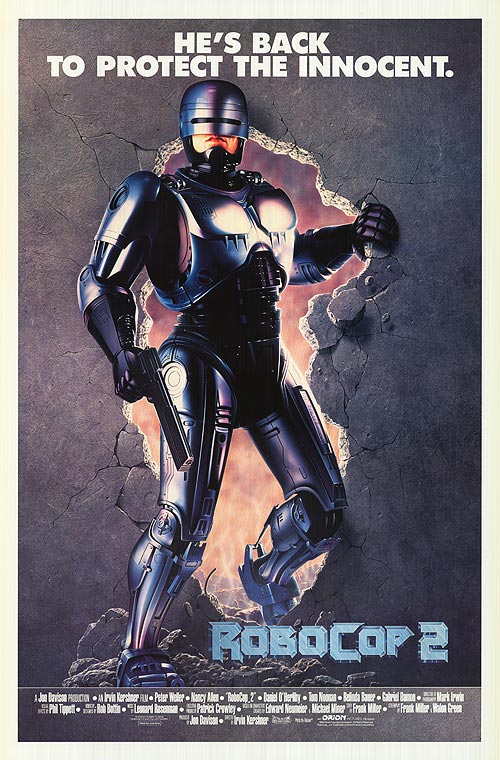
ROBOCOP 2 (1990) - Review

RoboCop 2

Action/Crime/Sci-Fi
1 hour and 57 minutes
Rated: R

Written by: Frank Miller & Walon Green
Directed by: Irvin Kershner
Produced by: Jon Davison

Cast:
Peter Weller
Nancy Allen
Daniel O'Herlihy
Tom Noonan
Belinda Bauer
Gabriel Damon


Even in the future of law enforcement there is room for improvement.

In 1987, audiences across the world were graced with the science-fiction/action film RoboCop, an intelligent and enormously entertaining motion-picture that served as an allegory regarding the dangers of consumerism, commercialism, conservatism, and Reaganomics. In essence, it was a commentary on the very nation it existed within - 1980s America - as well as a warning regarding that nation's future (much like the equally intelligent and entertaining sci-fi/horror film They Live, directed by John Carpenter). With RoboCop, director Paul Verhoeven hit audiences with all the sledgehammer subtlety of TV advertisements with a message to wake up and understand the world that was happening all around them. It's no surprise that this message resonated (kind of) to the point where the film was a commercial success. And where there's commercial success, as capitalism in the entertainment business has taught us, there's almost assuredly going to be a franchise, or at the very least a sequel.
For RoboCop's first sequel, the studio made an inspired, but perhaps safe choice, regarding who the man to replace Verhoeven in the director's chair ought to be. Irvin Kershner was most notorious for having directed Star Wars: Episode V - The Empire Strikes Back in 1980. With the enormous success and fan following for the Star Wars franchise that stemmed out of Empire, the studio was hopeful Kershner would be able to inspire the same sort of mega-fandom by directing RoboCop 2. So, how does RoboCop 2 manage as a piece of cinema, sequel or not?
Screenwriters Frank Miller and Walon Green recognized what worked in the first RoboCop and utilized these elements that made that movie both a box-office success and a piece of social commentary for their sequel. While there are fewer, randomly placed fake advertisements in RoboCop 2, the film does try to make some claims about consumerism, however, it is clear that these claims aren't the main focus of the overall point of the movie and that they in no way differ from what was already said in Verhoeven's first film. OCP is still an evil corporation that wants to privatize the municipal elements of Detroit simply for profitable gains. Nothing's changed at all.
The main focus of RoboCop 2 is the conundrum of a mass drug addiction epidemic - one that was mirrored by an occurring drug problem in the United States for years up to this point, and had really reached a boiling point around this time due to the government's declared War on Drugs initiative. With their script, and with Kershner's more than capable direction, Miller and Green attempted to create a commentary on a city (or a nation) plagued with a drug problem, and how said problem interacted with the corrupt business dealings and hostile corporate takeovers of governmental legislation that were simultaneously occurring.
If this sounds like it's too big of a quandary for an action/science-fiction film that is also trying to sell tickets and be entertaining enough to pull in theater patrons to try to make a logical point on, it's because it is. RoboCop 2 manages to fail in regards to making any kind of point on all of these societal evils that it exploits to craft its own story - other than, of course, what had already been said in the first movie. There is one moment within the film that must be commended for coming the closest to some sort of tangible societal commentary on these issues. In an exchange between the city's mayor and several council members, a drug lord offers to bail out the city's financial debt to the evil corporations. In exchange, the mayor would decriminalize the narcotic being sold, allowing for it to essentially be a legal and marketable product and for him to become a hero for "ridding the streets of crime." In this moment, Kershner, Miller, and Green seem to be making a commentary on the legalization of illegal substances in order to create a direct revenue stream for the government outside of corporate donations and influence. To top this off, the scene is interrupted by a literal killing machine that massacres all of them, a machine designed and sent by the corporations to do so, so that business can continue as usual with them at the top and in power. This scene, as remarkably brilliant as it is, unfortunately doesn't last long enough for its point to fully resonate. In the first RoboCop, the commentary was tangible throughout. Here, its clarity is only present in this all too brief scene.
Despite failing to live up to its predecessor's intelligent commentary, RoboCop 2 proves to be an entertaining enough action film on its own. Kershner, as evidenced by his handling of films like Empire and the James Bond movie Never Say Never Again, clearly knew how to orchestrate engaging sequences of violence and action, and RoboCop 2 delivers on both. A chop-shop sequence, where the hero is literally torn to pieces is intense to watch unfold - mainly for its lack of on screen violence (oil spraying instead of blood is a nice touch). An all out raid upon a warehouse toward the end of the film's second act proves to be the major highlight, and its great to see the clunky hero chasing after criminals in edge of your seat action that reminds viewers why they love these types of films in the first place. The climax battle does fall a little flat, but this again is because it is a retread of the confrontation in the first RoboCop. We've seen the hero battle a larger, more powerful cyborg before. Here it becomes redundant and boring.
The performances are decent enough in RoboCop 2. Peter Weller is great as Murphy yet again, but much is missing in regards to his human elements. What made Murphy great in the first RoboCop was his internal struggle between his past human life and his mechanical duties in the present to his corporate superiors. Murphy's memories are quickly fed to the audience in the first moments of RoboCop 2 but they're unfortunately just as quickly pushed aside and never brought back up. Nancy Allen, unfortunately, is underutilized in this film and her presence feels obligatory at best. In the first film she helped Murphy to remember who he was. Here, she's just sort of taking up space. Daniel O'Herlihy is wonderful as the OCP CEO hellbent on taking over Detroit for profit, and likewise Tom Noonan does an amazing job as the pseudo-religious drug kingpin, equally driven by profit and capital.
While it's nowhere near as intelligent as its predecessor and therefore hardly merits discussion regarding motion-pictures with any sort of societal worth or commentary, RoboCop 2 does prove to be an entertaining action movie that was constructed by a more than capable group of writers and a competent, and arguably under-appreciated, filmmaker with the pieces they were dealt. It's not a complete waste of time, and anyone who wishes to watch the film, again, keeping in mind that it won't live up to the same standards as its predecessor ahead of screening it, won't find it to be a painful viewing experience.

5/10

Sunday, March 18, 2018

DRACULA (1931) - Review

Dracula

Fantasy/Horror
1 hour and 15 minutes
Rated: Not Rated

Written by: Garrett Fort
Directed by: Tod Browning
Produced by: Tod Browning & Carl Laemmle, Jr.

Cast:
Bela Lugosi
Helen Chandler
David Manners
Dwight Frye
Edward Van Sloan


The story of the strangest Passion the world has ever known!

By 1931, Universal Studios had managed to make a great deal of money off of their first two monster-related pictures: The Hunchback of Notre Dame in 1923 and The Phantom of the Opera in 1925, both silent films that featured Lon Chaney as the iconic tragic figures of the tales. It was clear by the success of these two films that there was a clear and undeniable market within the horror genre, and Universal was eager to bleed that vein of success, especially with the advent of technology that allowed for sound to be synched with film effectively doing away with the silent-film era. Universal's first choice for a horror film in the talking-pictures era proved to be another enormous success for the studio: Dracula.
Dracula had already been adapted illegally in 1922 by German expressionist filmmaker F.W. Murnau with his movie Nosferatu. Due to this snafu, and the courts' ruling in favor of Stoker's widow in the following plagiarism lawsuit, producer Carl Laemmle, Jr. acquired the rights for Stoker's novel legally to ensure that nothing would derail the potential success of the film. But Laemmle didn't have to work hard in order to ensure that Dracula would be a success with audiences. It had already been adapted into a Broadway stage play that was receiving enormous success, and rather than align the film as closely to the book as possible, Laemmle and director Tod Browning opted instead to make the film version of Dracula resemble the play that audiences had come to adore. It was a safe move that, again, all but ensured the enormous success of the movie before it had even been released.
Tod Browning's Dracula proves to be an incredible movie, even still nearly ninety years after its release - and yet it is not a film without its shortcomings. For starters, the direction is brilliant. Browning's management of sequences and placement of performers within as well as their relation to the camera is extraordinary to behold. There are moments when the characters appear to be swallowed up whole by the enormous and breathtaking sets. In these moments, Browning and cinematographer Karl Freund wisely decided to utilize long shots effectively allowing for the sets to become a new character all on their own and push forward a breath of dread and gothic despair into the overall atmosphere. In other sequences, Browning and Freund just as wisely utilize tighter shots. There is one moment in particular where Count Dracula confronts Van Helsing in the home of Dr. Seward. This set is neither impressive nor is it meant to be viewed as another character the way that the sanitarium or Dracula's castle are, and because of this Browning cleverly lets the film's actors carry the scene instead of the surrounding atmosphere. It's truly easy to see just how brilliant of a filmmaker Tod Browning was based on the varying sequences throughout Dracula.
As already stated, Karl Freund's cinematography is remarkable to behold, and the lighting in many of the sequences is just astounding. It becomes clear based on Freund's lighting cues just where our attention as an audience should lie - on the sets or on the performers. Milton Carruth and Maurice Pivar's editing proves effective, most notably in sequences involving Dracula's transformations or his attacking of his victims. By leaving both off screen, a decision that was surely just as much Browning's as it was the film's editors, the movie takes on another level of dread allowing audiences to imagine those images for themselves. The surprising lack of a score also allows for dread to settle into the minds of the audience. Sequences where Dracula attacks and stalks his victims are riddled with tension-building silence.
Obviously, besides the sets, the most impressive thing about Dracula is its performances, namely one in particular. The supporting cast is relatively overshadowed by the talent of the film's black-cloaked leading role, but there are some who do standout and manage to hold their own against Lugosi. Edward Van Sloan as Van Helsing is terrific, and while he isn't as memorable as Lugosi's Count Dracula, Van Sloan's Van Helsing has some incredible moments in the film - in particular the already mentioned sequence between Van Helsing and Dracula in the home of Dr. Seward. Equally impressive is Dwight Frye's performance as Renfield. Renfield's character takes the place of Harker's from the novel, traveling to Transylvania to Castle Dracula in the film's first act. Frye's performance as the raving mad lunatic Renfield is both believable and at times truly scary. The image of him laughing below deck in the ship, staring up into the light at the men who have discovered him, is perhaps the most terrifying moment in the entire movie. There's a reason why rocker Alice Cooper appropriated the performer's name for a song about a madman decades later.
But it is, to no one's surprise, Bela Lugosi's performance as Count Dracula that really remains the number one reason why anyone ought to see Dracula all these years later. What is perhaps most surprising is that Laemmle and the other Universal executives did not originally want Lugosi to play Dracula in the film. Lugosi ultimately took an incredibly low salary for the film and lobbied against the producers until they relented and allowed for him to play the role that he had made famous on Broadway. Lugosi's Count Dracula, whether anyone has seen this film version of Dracula or not, remains so iconic that most individuals think of him first when the character is brought up - the widows peak, the piercing eyes, the Eastern European accent, the claw-like hands, the pale, bloodless face, and the raised eyebrows. Lugosi was a performer that could say and do more with an expression than most actors could deliver out of an entire film's performance. While Dracula may not be Lugosi's best movie, it will always be his most iconic movie - and it's very clear to see why.
Browning's Dracula does have its issues despite it being such an iconic piece of cinema. The comedic relief of both the maid and orderly characters feels misplaced and out of touch with the film's atmosphere, even by the standards of the 1930s. By injecting humorous characters who aren't actually funny into a gothic horror film, the audience is effectively drawn out of the viewing experience until those characters are removed from the scene. The biggest issue with the film though is that it doesn't follow Stoker's novel closely at all. As previously mentioned, this is an adaptation of the stage play which differs largely from Stoker's novel. Unfortunately, because of this the movie moves too quickly. We are never given time to get to know the characters more intimately the way that we do in the novel, so that when they're thrown into this whirlwind of nightmarish dread, it's entirely too difficult to really care one way or the other what happens to them. Similarly, the film's denouement seems to happen much too rapidly, leaving one wondering if it was that easy then why were any of these characters so afraid of Dracula from the start?
While Tod Browning's Dracula isn't without its flaws, it still remains to this day an iconic piece of cinematic history that showcases the talents of both a filmmaker and performer of yesteryear who both went largely unappreciated by the general public despite all of their respective aptitude.

8/10

Friday, March 9, 2018

THE STRANGERS: PREY AT NIGHT (2018) - Review

The Strangers: Prey at Night

Horror
1 hour and 25 minutes
Rated: R

Written by: Bryan Bertino & Ben Ketai
Directed by: Johannes Roberts
Produced by: Babak Eftekhari, Wayne Marc Godfrey, James Harris, Robert Jones, Ryan Kavanaugh, and Mark Lane

Cast:
Christina Hendricks
Martin Henderson
Bailee Madison
Lewis Pullman


Let us prey

In 2008, filmmaker Bryan Bertino unleashed upon audiences his low-budget, shocking home invasion horror film The Strangers which wound up being a surprising, but not unworthy, box-office success. Made on a budget of roughly nine million dollars, Bertino's film managed to rake in more than eighty million in profits when it was all said and done. The film's success was largely in part due to it being a movie that relied heavily on a simple storyline that effectively played off of audiences fears. This wasn't just a home invasion film about killers trying to get inside a home and murder their victims. This was a much more sinister story, where the killers didn't just want to end the lives of their victims, but also do everything in their power to express complete and total control over their victims by psychologically messing with their heads. This in effect, was also carried over onto the audience - allowing us as viewers to share in the fears and horrors of the onscreen characters as the nightmare played out. With the massive success of the film, Bertino promised almost immediately afterwards that there would be a sequel. A decade later, we've been given another chapter in this nightmarish saga.
The Strangers: Prey at Night is unquestionably a motion-picture that exists solely because its predecessor made money. There was absolutely no way that it was mapped out from the start. If Bertino had always intended there to be a sequel to his first flick, then The Strangers: Prey at Night more than likely would not have taken ten years to have been made, and Bertino would have had more control over the project than just a writer's credit. When the filmmaker of an original film steps aside for someone else to take the reins for the follow-up movie, it's usually not a good sign. Director Johannes Roberts ultimately has created a mixed-bag film that suffers from several problematic issues, but does, in fact, still manage to have some enjoyable qualities as well.
The film's storyline is both its biggest asset as well as its most problematic issue. For the entire first half of the film, Roberts seems to be attempting to remake the first film in every way possible. While there are now four victims instead of two, and the action takes place in a deserted trailer park instead of a house in the woods, Roberts tries to tap into the vein of the first movie by recreating the scares that worked so effectively in Bertino's movie, but here fall flat. The victims are toyed with in menacing fashion by their victimizers, the same obstacles are put in place (mainly phones being destroyed off-screen and victims discovering them later, total seclusion with escape seeming impossible, etc.), and even atmospherically, The Strangers: Prey at Night feels like a rehashing of The Strangers. As the victims peer outside windows we find ourselves, just like them, checking the shadows and looking for stalking figures on screen who may be watching them. This is ultimately problematic for one major reason: it no longer works. Bertino was lucky in that his film tapped into a raw and visceral horror that no one in its audience was expecting. Roberts isn't so lucky. By repeating the tones and atmospheres of the first movie in the first half of The Strangers: Prey at Night, we as an audience are ultimately ready for it and it doesn't work this time around. Ultimately, this first half - what could conceivably be called the "true horror" segment of the film - is not scary in anyway. It's a dull rehashing of something we have already experienced.
Partly to blame for helping with this rehashing - although not nearly as much as Johannes Roberts and Ben Ketai - are the film's technical decisions. Cinematographer Ryan Samul creates a dark and shadowy environment that's largely desaturated of color. It's an image that looks damn near identical to the images of the first film, and it does not help in anyway to differentiate The Strangers: Prey at Night from The Strangers. Editor Martin Brinkler allows for certain shots to linger perhaps longer than they should in attempt to create the same paranoia that the first film did. It's lazy recycling at its worst, and ultimately contributes to the first half of The Strangers: Prey at Night feeling like an unbearable revamping of The Strangers. Also, largely unimpressive, although not nearly as problematic as the already mentioned qualities, is the film's score, composed by Adrian Johnston. The piano/synth riff ultimately feels like something ripped off of a John Carpenter soundtrack or a Nox Arcana album, and although it may pair nicely with the mixing of 1980s pop tunes that work their way into the soundtrack, the score does nothing to either escalate the tension or create an atmosphere of dread.
It should be noted that it's been mentioned in this review that not only is the film's story its most problematic issue, but also its biggest asset. This essentially doesn't come into play though until right around halfway through the movie, where in an incredibly brilliant scene - one that will have you looking at swimming pools, light-up palm trees, and Bonnie Tyler's "Total Eclipse of the Heart" through completely different eyes in the future - the tone of the film shifts entirely, and The Strangers: Prey at Night effectively comes into its own by shedding the influences of its predecessor and trudging down a path not taken by Bertino's film. This is where the movie announces to its audience that all bets are off, and that this is no longer the rehashed invasion/stalker movie we were expecting, but a gut-churning survivalist film instead. In the above scene mentioned - the one with the swimming pool and Bonnie Tyler - Roberts manages to create a level of tension and dread that was missing from the first half of the movie. From here going forward, The Strangers: Prey at Night embraces its new identity and manages to create some engaging and memorable moments. With its heavy-handed homage to the ending of Tobe Hooper's The Texas Chain Saw Massacre as well as its questioning denouement aside, the second half of The Strangers: Prey at Night is an unexpectedly fun, tension-filled, survivalist horror movie that will leave audiences smiling, but perhaps confused or even angry as to why that wasn't the overall tone of the movie from the start.
The performances in The Strangers: Prey at Night, are largely what's to be expected from actors in this kind of movie. No one really shines to the point of brilliance on the screen, and due to its short running time, we are not given enough screen time to get to relate to the victims before they're ultimately submitted to the horrors of the plot in order to feel enough real empathy with them. Bailee Madison and Lewis Pullman are perhaps exceptions to this, coming the closest to reaching those qualities, and once the film comes into its own after the tonal shift, both performers do manage to win over the audience's affection and praise - Madison especially.
The Strangers: Prey at Night manages to be one of those motion-pictures that is both completely damned by its storyline but also earns redeemable points with its audience because of it. Director Johannes Roberts unfortunately falls into the trap of trying to recreate the magic of the film's predecessor and because of this, is responsible for the first half of his movie falling completely flat. However, once the film discovers its own identity, sheds its linkage to the first movie, and takes the audience in an unexplored and unexpected direction, The Strangers: Prey at Night manages to be an engaging film that will probably leave most viewers feeling like they didn't completely waste their time and energy by seeing it.

6/10

Saturday, March 3, 2018

NIGHTMARE CITY (1980) - Review

Nightmare City

Horror/Sci-Fi/Thriller
1 hour and 28 minutes
Rated: Not Rated

Written by: Antonio Cesare Corti, Luis María Delgado, and Piero Regnoli
Directed by: Umberto Lenzi
Produced by: Diego Alchimede & Luis Méndez

Cast:
Hugo Stiglitz
Laura Trotter
Maria Rosaria Omaggio
Mel Ferrer


The Nightmare Becomes Reality

After the outstanding box-office success of George A. Romero's zombie film Dawn of the Dead, a slew of imposter movies were created in rapid-fire succession, released upon the theater attending public like a horde of undead flesh eaters. Most famously was Italian Godfather of Gore Lucio Fulci's film Zombie, which was released one year after Romero's film and was also an international box-office success. With the surprise success of Fulci's Zombie, other Italian filmmakers were looking to cash in quick on the zombie craze before audiences became corpse-cold to the overall premise. One of those Italian filmmakers was Umberto Lenzi, who previously had proven himself a capable filmmaker with various different genre entries stemming from gladiator films to gialli flicks.
But Nightmare City could hardly be described as being Lenzi's first project pertaining to flesh eaters. Five years prior, Lenzi directed the jungle adventure film Man from Deep River which has gone on to be debatably called the first ever cannibal movie. That being said, if Man from Deep River's focus on cannibalism remains questionable, there can be no doubt about the consumption of flesh being the main topic of discussion in Nightmare City.
Perhaps looking to differentiate himself from both Romero and Fulci, Lenzi opts to give an explanation regarding the cause of the film's flesh eaters' motivations. Borrowing a hinted at solution from Romero's earlier zombie film Night of the Living Dead, Nightmare City lets its audience in on the fact that its zombies aren't technically zombies at all, but infected human beings. These flesh eaters have been over exposed to nuclear radiation, which in turn has altered both their physical flesh and their mental instincts. Nightmare City sets itself apart from both Dawn of the Dead and Zombie, aligning itself more closely with yet another earlier Romero film, The Crazies, by being a contagion film instead of a true blue zombie movie. The differences are subtle on face value, but here one does not see the slow meandering zombies that Romero popularized. These infected people can run and utilize weapons when it comes to hunting down their human prey. It is something that Lenzi ultimately is able to get away with purely because the film sets the clear distinction in place from the minute the bloody mayhem begins.
Speaking of the bloody mayhem, Nightmare City's gore effects are unquestionably its strongest asset. Special effects artists Franco Di Girolamo and Giuseppe Ferranti clearly saw the extreme levels of blood and guts that this subgenre of horror was destined for with future films like Romero's Day of the Dead and Fulci's The Beyond, and boy do they deliver the goods. Multiple heads are shown to explode from gunshots in fantastic close-ups, a man is impaled by a speargun, multiple stabbings become the norm, and there's even a tip of the hat to Zombie in an intensely graphic eye gouging sequence. Perhaps the most upsetting and arguably most unnecessary effects deal with two sequences where separate female characters have their breasts mutilated in horribly graphic detail. This obsession with breast mutilation is showcased in other films of Lenzi's, such as Cannibal Ferox, and is undeniably sexist. There's a line between a good bit of graphic fun in the name of good-humored horror films, and too much existing only for sadistic purposes of the filmmakers. Unfortunately, this is a line that Lenzi was often times quite fond of crossing throughout the course of his career. Nevertheless, the gore effects, for the most part, do remain both impressive and fun. Equally impressive are the film's makeup effects, also handled by Di Girolamo and Ferranti. The infected people look wildly different from the decayed zombies of Fulci's and Romero's films, as is the intention. Here we see various degrees of what appear to be burned and disfigured individuals, or more or less what one would expect to happen to the human body if one were exposed to high amounts of nuclear radiation.
Unfortunately, despite its radically different storyline from the zombie films before it (not including the contagion flick The Crazies, as mentioned), Nightmare City remains a rather dull and unimpressive film when it comes to its story. Not much really occurs in the way of plot. Once the infection is introduced, we're taken from one character to another who either thwart off their attackers, or succumb to a grim and brutal fate. This continues all the way until the film's third act. No stakes are ever raised, no potential cure is introduced, and ultimately, because of its switching between so many characters, no real connections can be made by the audience to the characters they are watching. Perhaps even more damning than its dull storyline though is Nightmare City's plot twist, delivered as the surprise conclusion of its climax. While the twist is shocking, it is only so because of just how unbelievable it is. What Lenzi essentially does is pull the rug out from underneath the audience, hitting them over the head with such a drastic twist, then asks that the slate be wiped clean entirely regarding the previous majority of the film that has just been watched. It of course ends on a "cliff hanger" letting us wonder if what we had seen already happened, didn't happen but is about to, or won't happen at all. It's a bit unfortunate and feels more as if writers Antonio Cesare Corti, Luis María Delgado, and Piero Regnoli were just out of ideas by the time they reached the end of their script and inserted the most ludicrous conclusion they could come up with.
The performances in Nightmare City are entirely unimpressive, the biggest contributor to said problem being the already mentioned lack of time spent with the characters to provide for a more intimate connection between them and the audience. Laura Trotter manages to scream her head off like any other typecast blonde in a horror movie, but that's really the extent of her contributions. Mel Ferrer as the in charge general never feels threatening nor important enough to be a focus to the story's overall point. In fact, he has nothing more to do than offer up exposition. The film's hero of course is meant to be Hugo Stiglitz's character, but perhaps the only impressive thing about Stiglitz is his beard.
Nightmare City is not without its charms though. Other than the already mentioned brilliant special effects work, the film boasts a terrific score. Composer Stelvio Cipriani delivers a nice 1980s-style synth score that, while isn't anywhere near as brilliant as Goblin's score for Dawn of the Dead or Fabio Frizzi's and Giorgio Tucci's score for Zombie, manages to hone in on the same fun and entertaining atmosphere that the two more successful films had. Lenzi, for all of his bad qualities, does manage to create some rather brilliant and engaging moments within Nightmare City that are frightening and riddled with tension. A sequence where Laura Trotter's character is searching through a hospital with no power and comes across some infected individuals is rather creepy, and, similarly, a sequence regarding a young couple being killed along a country roadside is heartbreaking to watch - perhaps in regards to how close this movie came out to the real-life Zodiac murders and the murders committed by Ted Bundy. The film's climax, set in an abandoned amusement park, where both Stiglitz's character as well as Trotter's have to fend off an impossibly large horde of infected monsters is the kind of edge of your seat excitement that should have been present throughout the entirety of Nightmare City.
Despite some problematic issues, including a dull storyline, characters that remain rather unimpressive, a ludicrous twist conclusion, and some blatantly sexist undertones which seemed to be a theme in the filmmaker's canon, Nightmare City remains a decently impressive entry into the zombie-movie archives largely for its attempts to differentiate itself from the more popular films that had come before it, thus setting a precedent for later, more successful, contagion films that would follow in its footsteps.

6/10